
« 16 December 2025 09:00: Laura Murphy: Shifting international dynamics and academic freedom: How can university autonomy be protected? | Main | Reminder: CfP 18th EAJS International Conference 2026 in Poznań (Poland) »
December 24, 2025
New Journal Article: The Manchukuo Red Cross Society and the Kwantung Army's Nation-Building Project in Manchuria, 1938-1945
Dear Colleagues,
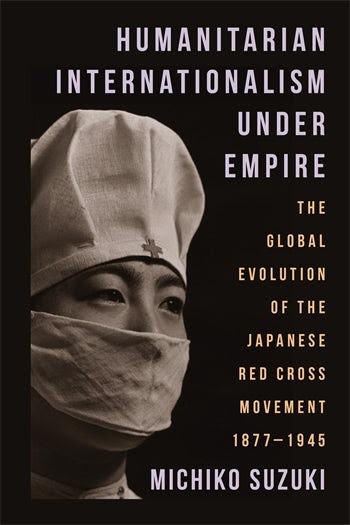
I am pleased to announce the publication of my new journal article. For details, please see below.
"The Manchukuo Red Cross Society and the Kwantung Army's Nation-Building Project in Manchuria, 1938-1945." Asia-Pacific Journal: Japan Focus, Vol. 23. Cambridge University Press, 2025.
Abstract:
This article situates the Manchukuo Red Cross Society (MRCS) within the historiography of the Kwantung Army's project to create an independent state in Northeast China, friction with Japanese interest groups already established in Manchuria, and the participation of ordinary Manchurians in state-sponsored organizations. It argues that the Kwantung Army's sponsorship of a Manchukuo "national" Red Cross society reflected the accelerating pace of the Shinkyō government's institutional development and pursuit of international recognition as a sovereign state. It also shows that the MRCS project encountered, and only partially overcame, opposition from on the one hand, the Japanese Red Cross Society (JRCS), which, since the Russo-Japanese War had established a strong institutional presence in Manchuria that it was reluctant to relinquish and, on the other hand, from the Geneva-based International Committee of the Red Cross (ICRC), whose president deferred to the Swiss Foreign Ministry and overrode senior staff in refusing the MRCS membership status. Nevertheless, once established, the MRCS developed into a multi-ethnic and multi-national humanitarian organization that mobilized both the Chinese population and the Japanese immigrant community, engaged with local governing authorities, and enlisted thousands of common people in the movement, and to this extent, furthered the Kwantung Army's nation-building project.
--
Dr Michiko Suzuki
Project Researcher
Graduate School of Economics, The University of Tokyo, Japan
Email: misuzuki@e.u-tokyo.ac.jp
Approved by ssjmod at 04:59 PM